
Only about 6.7% of Singaporean adults had a net worth of USD $1 million or more, according to UBS's 2025 Global Wealth Report (based on end-2024 data) — call it roughly 1 in 15. And yet being a "millionaire" here doesn't automatically mean you're wealthy — not when a $2.5 million home has become the benchmark a lot of buyers are aiming for. I get asked constantly during consults: should I stretch to $2.5 million? Go landed, 99-year leasehold, or freehold condo? Should I sell one property and buy two?
The question I actually care about isn't "what can you buy." It's what's sustainable, and what sets you up for a smart exit later. Here's the framework I use with clients weighing a $2.5 million budget.
Wondering how this affects your own timeline?
Every zone and every buyer's numbers are different. Get a personalised read on the Draft Master Plan for your situation.
What It Actually Takes to Qualify
Note: the loan, interest rate, and cash top-up figures below reflect market conditions as of August 2026 and are meant to illustrate the method, not serve as a live quote — TDSR thresholds, mortgage rates, and your own qualifying income will all shift over time, so treat these as a worked example rather than current pricing.
At 75% loan-to-value, a $2.5 million purchase means borrowing $1.875 million. Under TDSR, that requires roughly $16,400 in household income, assuming no other debt obligations like car loans. Your down payment — including stamp duty and legal fees — works out to around $720,000 to $730,000.
Here's where resale and new launch diverge sharply. On a $2.5 million resale property, the monthly instalment runs about $6,500 at current interest rates. CPF Ordinary Account typically covers around $3,400 of that, leaving a cash top-up of roughly $3,100 a month from day one — assuming a dual-income household splitting $16,400 evenly.
A $2.5 million new launch looks completely different in the first few years. Because of progressive payment, your CPF contributions typically cover the entire instalment for the first three years — meaning zero cash top-up, and in some cases you're even accumulating surplus CPF OA along the way. That's not an argument that new launch is automatically the better choice — it's simply a different cash flow shape, and both eventually converge to a similar commitment once the project completes.

My Three Golden Principles
Whatever budget you're working with, I fall back on the same three principles with every client:
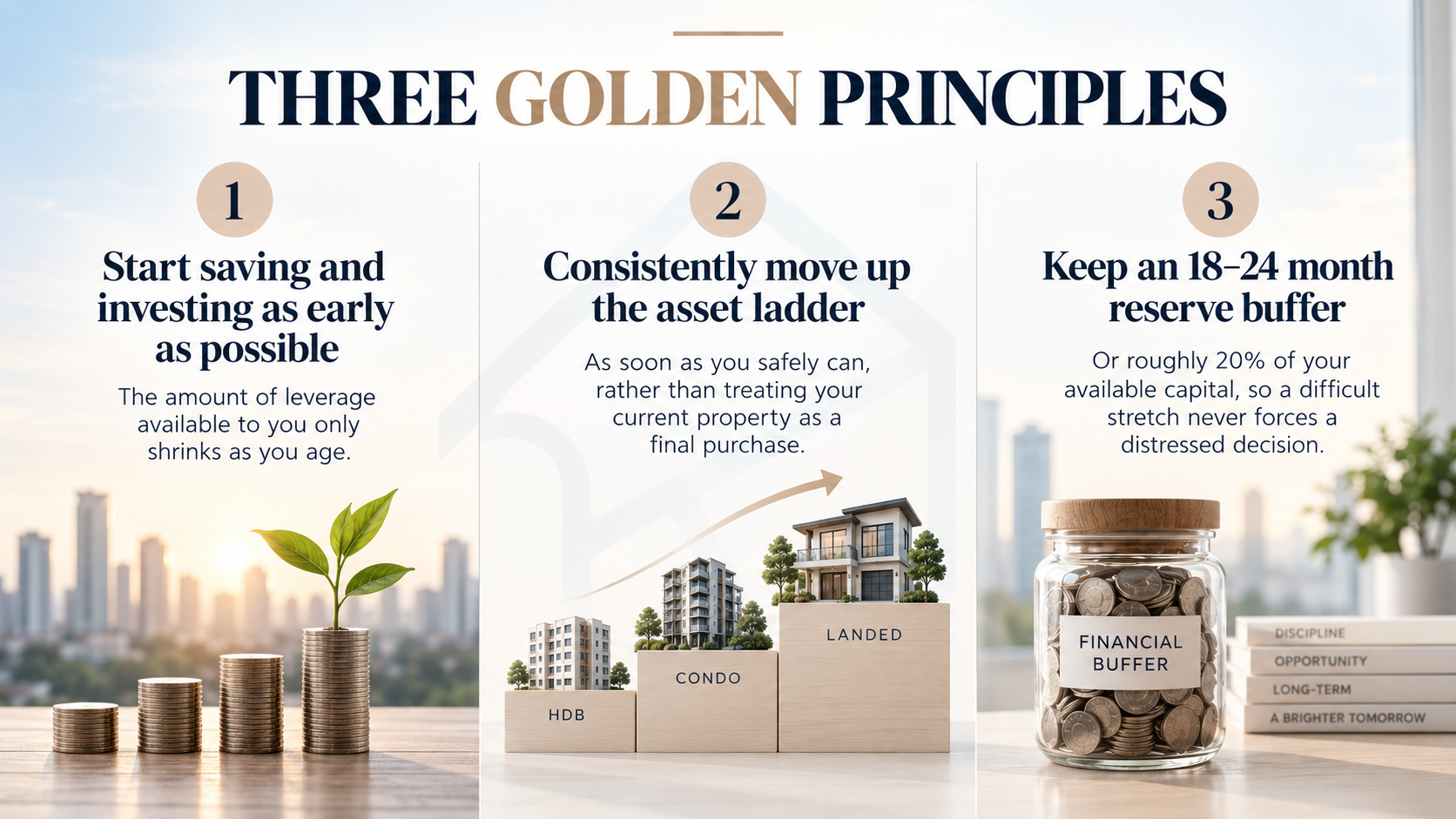
Why $2.2 Million Might Be the Smarter Number
Money can be made in plenty of places — stocks, small businesses, even watches. So before you max out a $2.5 million budget, ask yourself: do you still have a buffer for opportunities, or rainy days? I tell clients constantly — don't max out your budget just because the bank will lend it to you, and don't max out because your friend bought bigger.
If $2.5 million is genuinely your ceiling, I'd suggest $2.2 million is the sweeter spot. That gap — roughly $90,000 to $100,000 — becomes your safety buffer for renovation, emergencies, or simply not feeling like every dollar is spoken for. I practised what I preach here: my own budget was $3 million (I could have stretched to $3.2 million), but I bought at $2.6 million specifically to keep a 20% buffer intact.
There's also an exit-price argument. If you buy resale at $2.2 million right now, nearby new launch pricing in a comparable location is already trading above $2.6 million — meaning you're entering with a reasonably tested exit price already established above you. Buy at your absolute ceiling of $2.5 million, though, and your effective target exit becomes closer to $3 million, which is a taller ask if $2.5 million wasn't sitting inside a buffer to begin with.
Three Ways to Deploy a Sub-$2.5 Million Budget
Option 1: RCR resale, roughly $2.2 million. Suits buyers with a genuine own-stay need — no option to move in with parents — and who are comfortable with a longer 10 to 15 year holding horizon. The trade-off is a higher monthly cash top-up than new launch, but you get immediate space, established amenities, and schools nearby.
Option 2: OCR new launch, roughly $2.2 million. Makes more sense if you're treating this purchase primarily as a capital-building exercise rather than pure own-stay, and you have a place to stay in the meantime — typically with parents. The lower cash top-up in the early years frees up capital, though you're trading that for a longer wait to completion.
Option 3: $1.8 million four-bedroom OCR, save toward a second property. The lowest-risk approach for families who strongly want to own two properties eventually. You'll have less choice on location — likely not walking distance to an MRT — and a smaller subsequent budget means fewer options on the second purchase too. But it's a genuinely conservative, staged path to a larger combined portfolio.
So, Should You Buy at $2.5 Million?
Option 1 suits strong own-stay needs with uneven household income and a long holding runway. Option 2 suits buyers prioritising capital growth who are willing to delay gratification. Option 3 suits low risk appetite and a strong desire for two properties down the line.
None of these is the "correct" answer in isolation — it depends on your income structure, your family's timeline, and how much stress you're actually willing to carry every month. If you want to run your own numbers against this framework, that's exactly the conversation worth having before you commit to a number.
Get in touch with our team for a personalised assessment →

Have a specific area you're weighing?
Get in touch and I'll walk through what the Draft Master Plan means for your situation directly — no obligation.