For years, I've heard the same complaint from buyers: prices are too high, developers are overpaying, the market is stuck. Honestly, I don't think they're entirely wrong — in close to two decades in this industry, there's never been a year where people told me prices were cheap. But I think most buyers are comparing against the wrong benchmark. A savvy investor doesn't just compare today's price to yesterday's. They compare today's price to what tomorrow's launches are likely to cost, using the master plan and land data as the guide.
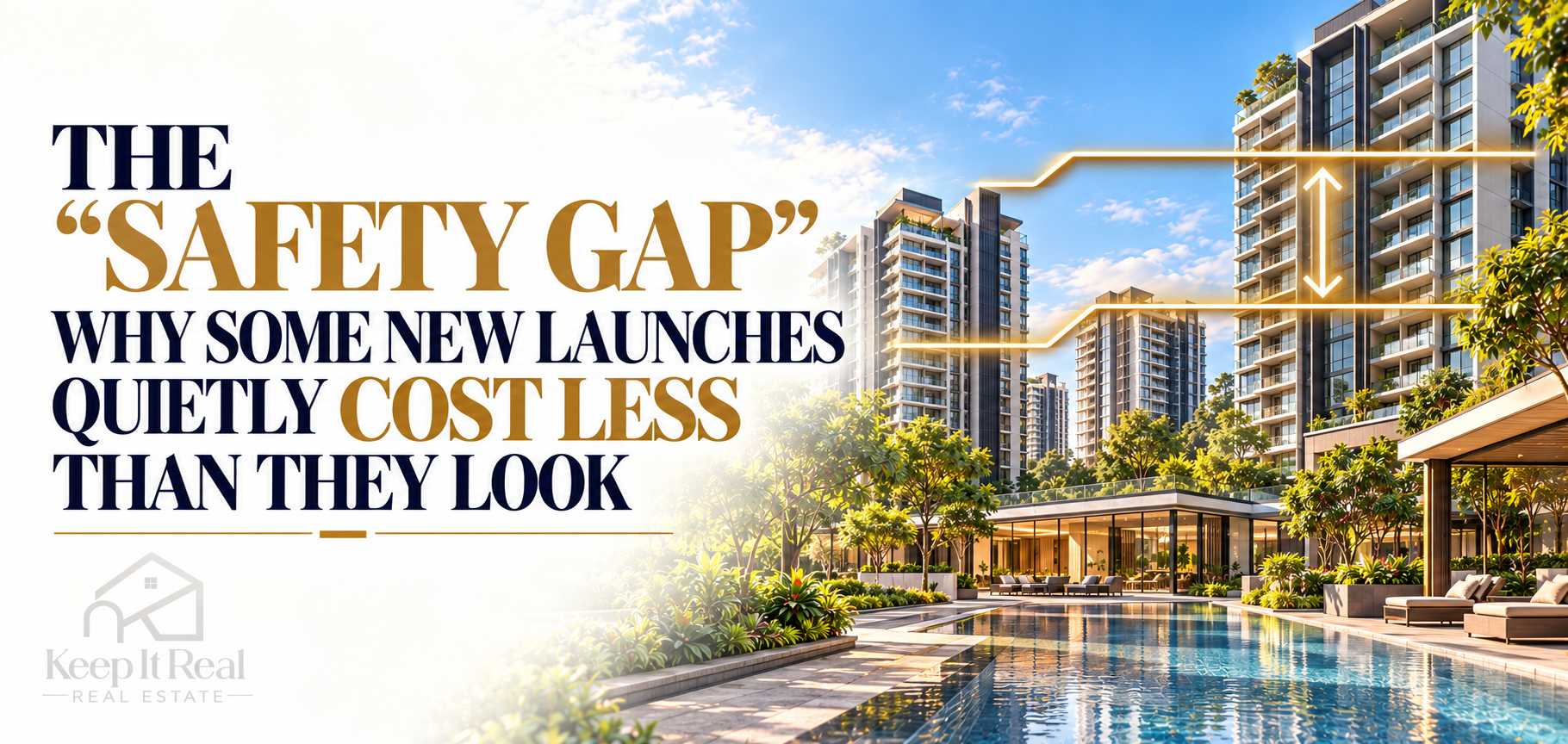
That comparison points to something I think is genuinely misunderstood: the "Safety Gap."
Wondering how this affects your own timeline?
Every zone and every buyer's numbers are different. Get a personalised read on the Draft Master Plan for your situation.
Why Land Cost Matters More Than the Headline Price
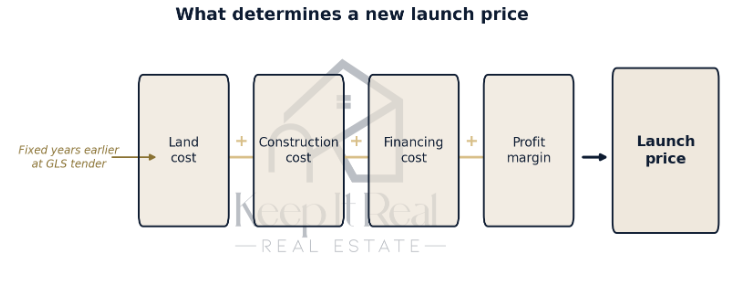
When a developer prices a launch, the number isn't set by mood or market sentiment — it comes down to land cost, construction cost, financing cost, and profit margin. Of those, land cost is the one that gets fixed years before the launch actually happens, at the point the developer wins the Government Land Sale (GLS) tender.
That timing gap is the whole idea. Today's land cost effectively determines tomorrow's pricing benchmark — which means the interest rate and competitive environment at the time the land was bought matters just as much as anything happening in the market today.
A Historical Case Study: Lentor
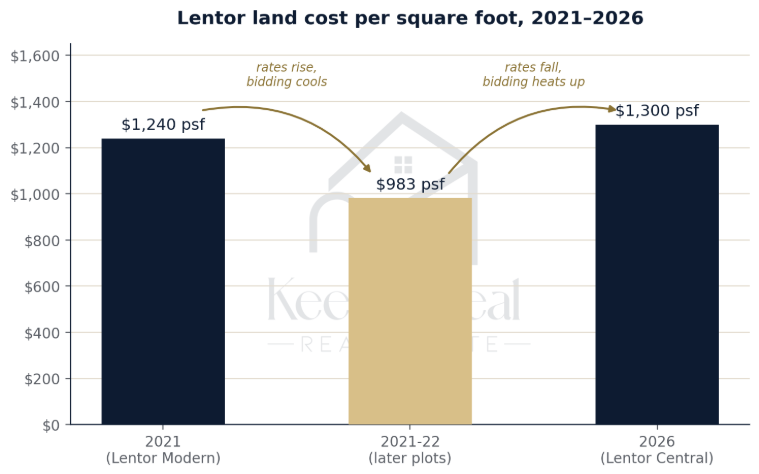
Lentor is one of the clearest examples of this dynamic I've seen play out. Back in 2021, Lentor Modern's land was acquired at roughly $1,240 psf per plot ratio — a period of near-zero interest rates, cheap financing, and high developer confidence, which pushed bidding higher.
What happened next was counterintuitive. As interest rates climbed and fear entered the market, developer participation in subsequent Lentor land tenders dropped, and later plots were acquired at roughly $982–985 psf — despite the MRT being operational by then and the township considerably more proven than it was in 2021. Logically, more proof of concept should mean higher land prices. Instead, elevated financing costs (effectively 3–4x higher than the COVID-era environment) pushed bidding down, even as the fundamentals improved.
The result: projects built on that later, cheaper land effectively carried a lower cost base into a stronger location story. Lentor Modern itself went on to post full profitability across its launched units, with some owners recording gains in the 20–30% range over a multi-year holding period — though, as always, individual outcomes vary and past performance in one project doesn't guarantee the same result elsewhere.
The Safety Gap, Defined
Here's the concept in plain terms: at any point in time, you are always buying at a record-high headline price. That's true in every market, every year — ask anyone what they paid for their first HDB flat, and their parents will tell them it wasn't cheap at the time either. The mistake many buyers make is treating "prices are at a record high today" as a reason to wait indefinitely, when it's been true in every prior season too.
The Safety Gap is the window where a project launching today is still built on land acquired in a different, more cautious rate environment — years before renewed competition and falling rates pushed subsequent land tenders higher. You get to buy into a strengthening location story while the project's underlying cost base still reflects the more conservative pricing environment the developer originally bought into.
This gap isn't permanent. Once enough new land tenders are won in the current (often more competitive, higher-cost) environment, that becomes the new benchmark, and the gap closes — future launches simply cost more, because the input cost genuinely was higher.
How to Actually Use This Framework
Rather than asking "is this project expensive," the more useful question is: what did the developer pay for this land, and when? A few practical ways to apply it:
- Check the land tender date and psf, not just the launch price. A project launching this year could sit on land bought two to four years earlier, in a completely different rate environment.
- Compare recent land tenders in the same micro-market. If the most recent GLS bid for a similar plot nearby came in meaningfully higher than the land under a soon-to-launch project, that's a live signal of where the next benchmark is heading.
- Weigh certainty against cost. Waiting for more proof — a completed MRT, a formed township, a visible transformation — isn't wrong, but it usually comes at a price, since land tenders typically get more competitive (and expensive) once the outcome is more certain. That's arguably the "insurance premium" for greater certainty, and it's a legitimate trade-off — just one worth making consciously rather than by default.
- Recognise that this window closes. Once a few rounds of land tenders have been won at the new, higher benchmark, the Safety Gap for that particular pocket is effectively gone until the next rate or sentiment cycle creates a new one elsewhere.
The Real Question to Ask Yourself
When clients ask me whether they should wait, I don't have a universal answer — but I do have a question back: what are you actually waiting for? If it's more certainty, it's worth being honest that greater certainty is very often priced in by the time it arrives, in the form of a higher land cost benchmark for whatever comes next. There's nothing wrong with paying for that certainty if it genuinely helps you sleep at night — the same logic as paying for insurance on something that may never happen. But it's worth knowing that's the trade-off you're making, rather than assuming you're simply "waiting for a better price."
If you want help identifying whether a specific project you're considering is still inside its Safety Gap, or already reflects the new benchmark, that's exactly the kind of analysis worth walking through together.
Get in touch with our team for a personalised assessment →

Have a specific area you're weighing?
Get in touch and I'll walk through what the Draft Master Plan means for your situation directly — no obligation.