
This is easily the most common question I get. You have the budget to move into a landed property, but let's be honest; the landed homes actually within reach right now aren't your dream home. Maybe it's District 19 instead of District 10. Maybe the land size isn't what you pictured. Maybe the car porch is smaller than you imagined for your "forever home."
So the instinct becomes: decouple first, keep your current place, buy a smaller second property as a hedge, and wait until you've saved enough for the real landed home you actually want. It sounds safe. But then the second-guessing starts. Will you be priced out of the landed market by the time you're ready? Will that second property even keep pace with landed price growth in the meantime?
The honest answer depends less on the market and more on where you are in your career cycle. Here's how I'd think through it.
Wondering how this affects your own timeline?
Every zone and every buyer's numbers are different. Get a personalised read on the Draft Master Plan for your situation.
The Real Cost of Waiting
The biggest risk I see clients take isn't a bad property decision — it's no decision at all. Analysis paralysis is real: waiting for the perfect house, the perfect price, the perfect correction. In Singapore's property market, the perfect entry point is usually yesterday, in hindsight.
My own journey wasn't built by waiting for a dream landed home either — I moved step by step, HDB to condo, condo to multiple condos, eventually to landed. Even my first landed property wasn't my ideal one. No ego decisions, no trying to time the market — just consistent, safe progression. When people hold out for the perfect price, the market usually moves before they do, and they end up further from their goal than when they started.
That said, "don't wait" isn't licence to rush. Whichever path you choose — entering landed now or decoupling to hedge — the same discipline applies: do your own due diligence, and maintain at least 18 months of instalment buffer regardless of which route you take. Sitting entirely in cash out of fear has its own cost too — inflation quietly erodes purchasing power every year you're not positioned in an asset.
If You're in Your 30s or Early 40s: The Upward Trajectory Phase
If your income is still growing and you haven't hit your career ceiling, your biggest asset right now isn't your current property — it's your future earning power. This stage has real structural advantages worth using:
- CPF support is stronger while you're younger. The proportion of your CPF contribution allocated to your Ordinary Account is higher earlier in your career and gradually decreases as you age.
- Promotions, job changes, and bonus growth are still ahead of you. Most people haven't hit their income ceiling yet at this stage.
- You have time to recover from a suboptimal decision. If a purchase doesn't turn out ideal, you still have runway to adjust and upgrade again.
But being young isn't licence to be careless — one poorly considered landed purchase can genuinely set back years of progress, because you're locking in stamp duties, legal fees, renovation costs, and cash that becomes hard to unwind once spent.
In this phase, you generally have two paths: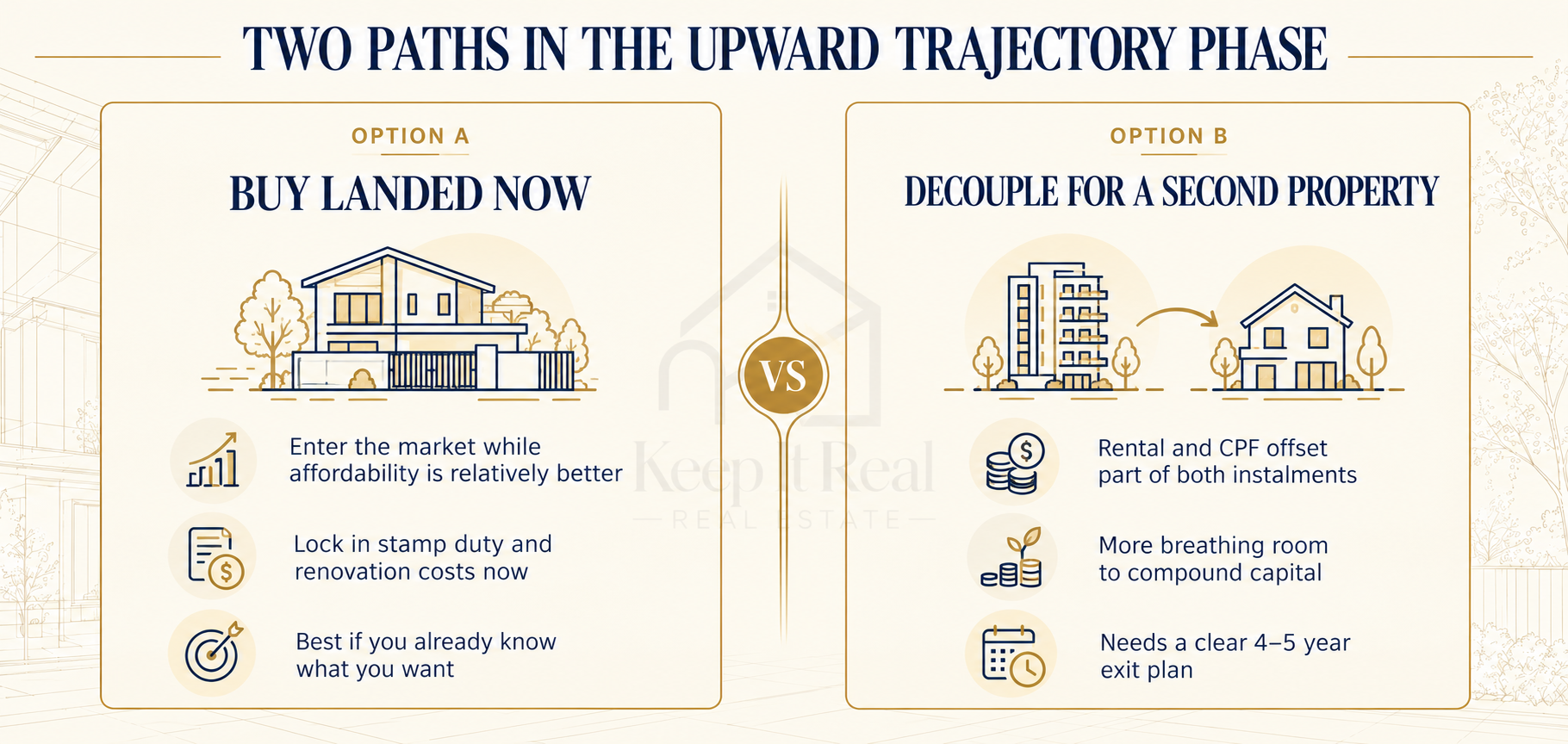
Option A: Buy landed now, even if it's not the ideal house, to enter the market early while affordability is relatively more favourable.
Option B: Decouple to buy a second property first. Structured properly, you're rarely paying the full instalment on both properties simultaneously — rental income offsets part of it, and CPF covers another portion, giving you more monthly breathing room and more capital to compound while your career is still climbing. By the time your lifestyle needs are clearer and your risk appetite has grown alongside your asset base, you're in a stronger position to make the landed decision with real conviction.
My honest take: if you're taking the capital-building route (Option B), be genuinely selective. Don't buy something just because it's cheap and within reach — buy something with a clear 4–5 year exit plan and real resale demand. A property that barely appreciates, or worse, depreciates, isn't building wealth — it's just locking up capital that isn't even keeping pace with inflation. The entire point of this bridge property is to get you closer to landed, not stuck halfway.
If You're Mid-Career: The Unknown Phase
This phase is different. Your career trajectory feels less certain, there may be unplanned costs on the horizon (ageing parents, children's overseas education), and there's simply more financial unknowns pulling at your capital. If owning landed property is genuinely a priority for you at this stage, particularly if it's part of legacy planning for your children, waiting rarely makes things easier. In most cases, it makes affordability tighter, since your CPF OA allocation continues shrinking and your available loan tenure continues shortening with age.
If you're entering the landed market at this stage, do it deliberately:
- Secure at least 18 months of instalment buffer in cash before committing, so a job transition or unexpected expense doesn't force a distressed decision.
- Understand the full cost stack; stamp duty, legal fees, renovation, and ongoing maintenance (landed maintenance is meaningfully higher than condo MCST fees); not just the headline purchase price.
- Know your structural options. If your loan quantum is tight, short-term financing structures can sometimes improve eligibility. Loan tenure itself is capped by MAS rules — generally up to 35 years for private property, and structured so the loan is fully repaid by around age 65 for full loan-to-value eligibility (some banks may extend repayment toward age 75 in specific cases, but typically at a reduced loan-to-value ratio and higher downpayment). These are tools to preserve flexibility, not shortcuts around the underlying affordability math.
My Honest Advice
Look at your income runway, loan eligibility, CPF position, and holding power — in that order. If you're still on a strong upward income trajectory with a long runway ahead, you genuinely have the luxury of choosing: enter landed early, or build capital first and upgrade with more clarity later. Either can work — the key is choosing intentionally rather than defaulting into one out of fear or FOMO.
If you're mid-career with income growth less certain, shortening loan tenure, and a shrinking CPF allocation, waiting typically doesn't buy you safety — it buys you tighter affordability. If landed ownership is part of your family's legacy plan, that's worth acting on with structure, not emotion.
Whichever position you're in, the one rule that doesn't change: never stretch without a buffer. Every property situation is different enough that a general rule of thumb only gets you so far — if you want clarity on which phase you're actually in and what that means for your numbers, that's worth a real conversation.
Get in touch with our team for a personalised assessment →

Have a specific area you're weighing?
Get in touch and I'll walk through what the Draft Master Plan means for your situation directly — no obligation.