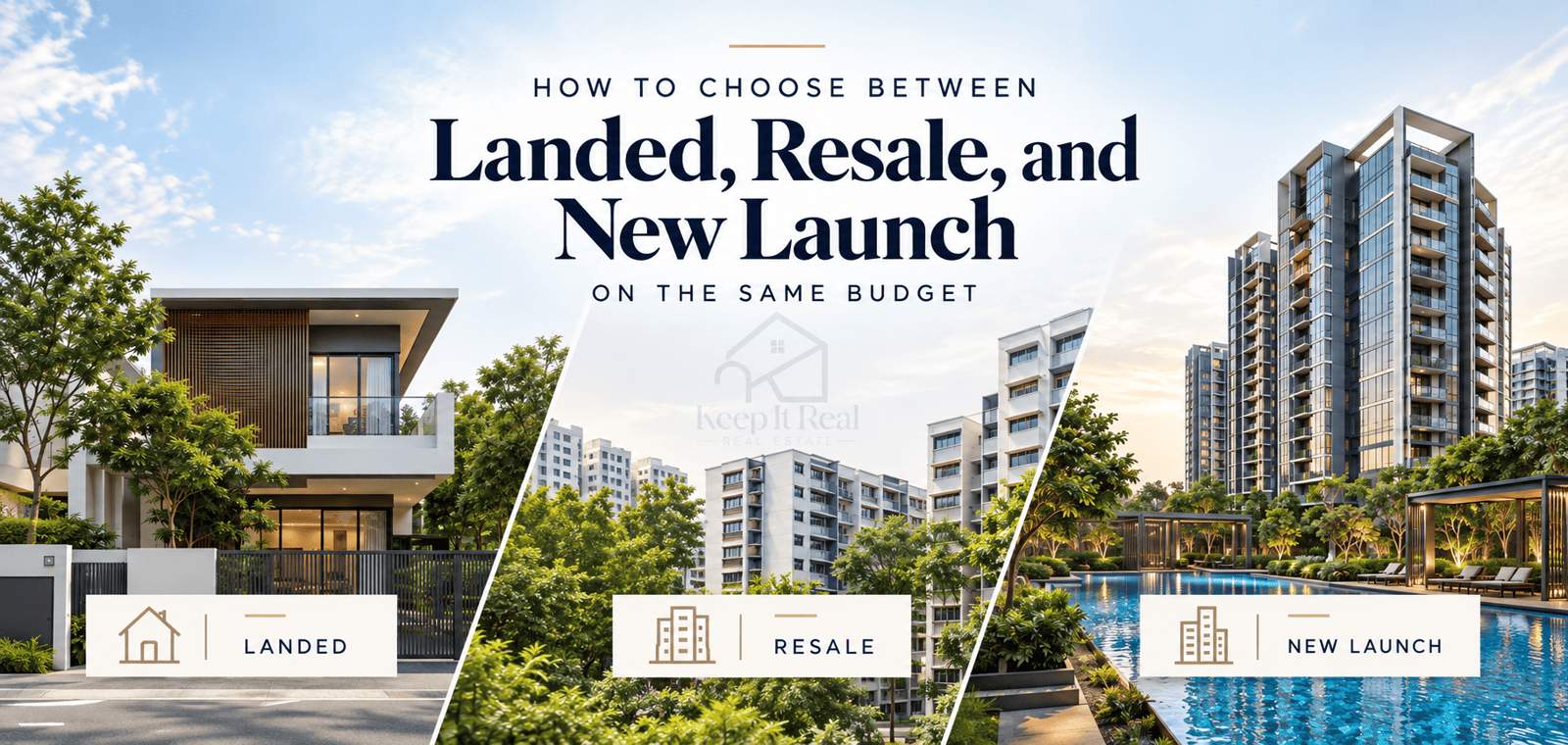
I was recently deciding on my own $3 million property purchase, and it kept me up at night — literally. With that budget in Singapore, you're not choosing between similar options. You're choosing between three fundamentally different cash flow profiles: a landed property, a resale condo, or a new launch. Each comes with a different monthly top-up, a different holding period, and a different risk profile.
Rather than just telling you what to buy, I want to walk through the actual framework I use to compare these options side by side — mortgage, rental offset, and four-year holding cost — so you can run the same exercise on your own numbers, whatever your budget happens to be.
Note: the specific prices and psf figures below reflect the market as of August 2025 and are used purely to illustrate the comparison method — treat them as a worked example, not current pricing. The comparison framework itself doesn't go stale even when the numbers do.

Wondering how this affects your own timeline?
Every zone and every buyer's numbers are different. Get a personalised read on the Draft Master Plan for your situation.
Option 1: Landed Property
At the time, a landed property in this budget range worked out to roughly $2,200 psf on land size, with a 75% loan-to-value mortgage producing a monthly repayment of around $10,000 over a 23-year tenure.
Landed rental yields tend to be lower relative to entry price than condos — a tenant doesn't pay a premium for freehold status the way a buyer does. Using a conservative rental estimate and after accounting for income tax, the net rental income covered only a portion of the mortgage, leaving a monthly cash top-up of around $6,000. Add maintenance — typically higher for landed property than condo MCST fees, especially for an older unit — and the realistic monthly top-up landed around $6,500.
It's worth breaking that number down further: a meaningful portion of every mortgage payment goes toward principal, not interest. So while $6,500 is what leaves your pocket each month, a large share of it is actually going into building your own equity — it's forced savings, not pure cost.
The real question to ask yourself: can you comfortably absorb a $6,000-plus monthly top-up, every month, without it affecting how you sleep at night?
Option 2: Resale Condo (RCR)
A four-bedroom resale unit in the RCR, priced at roughly $2.99 million, produced a similar $10,000 monthly mortgage — but with meaningfully higher rental income relative to entry price than the landed option. After tax, net rental income covered most of the mortgage, leaving a monthly top-up of roughly $3,750 including maintenance.
This assumes resale prices grow only with inflation (roughly 1–2% a year) unless there's a specific catalyst pushing the area higher. If both partners in a household are working with above-median income, CPF contributions alone can often cover a top-up in this range — meaning rental plus CPF absorbs most of the mortgage, while you're still building meaningful equity every month.
The real question: are you comfortable topping up $3,000–4,000 a month on top of your existing commitments, and do you believe the resale price you're paying still leaves room for the next buyer to profit too?
Option 3: New Launch (OCR 4-Bedder or RCR 3-Bedder)
New launches work differently because payment is staged against construction milestones (the progressive payment schedule), rather than starting at 100% from day one. That means the cash top-up starts small and increases gradually as the project nears completion — a materially different cash flow shape from the two resale options above.
One detail worth knowing: around TOP (Temporary Occupation Permit), buyers are typically only paying about 85% of the eventual monthly instalment, which often creates a window of 9 to 12 months of comparatively easier cash flow before the final payment kicks in at CSC (Certificate of Statutory Completion).
The real question: are you comfortable with a lower upfront commitment today, in exchange for uncertainty over what pricing and demand will look like when the project completes in four to five years?
My Personal Take
There's no version of this comparison that guarantees which option makes the most profit after four or five years — nobody can promise that. What actually matters is holding power: a plan you can comfortably sustain for the entire period, regardless of which way the market moves in between.
That's why I always put the options into one table — mortgage, net rental, monthly top-up, four-year total — and look at it at a single glance. The option that lets me sleep well at night usually reveals itself once the numbers are laid out side by side, rather than being decided in the abstract.
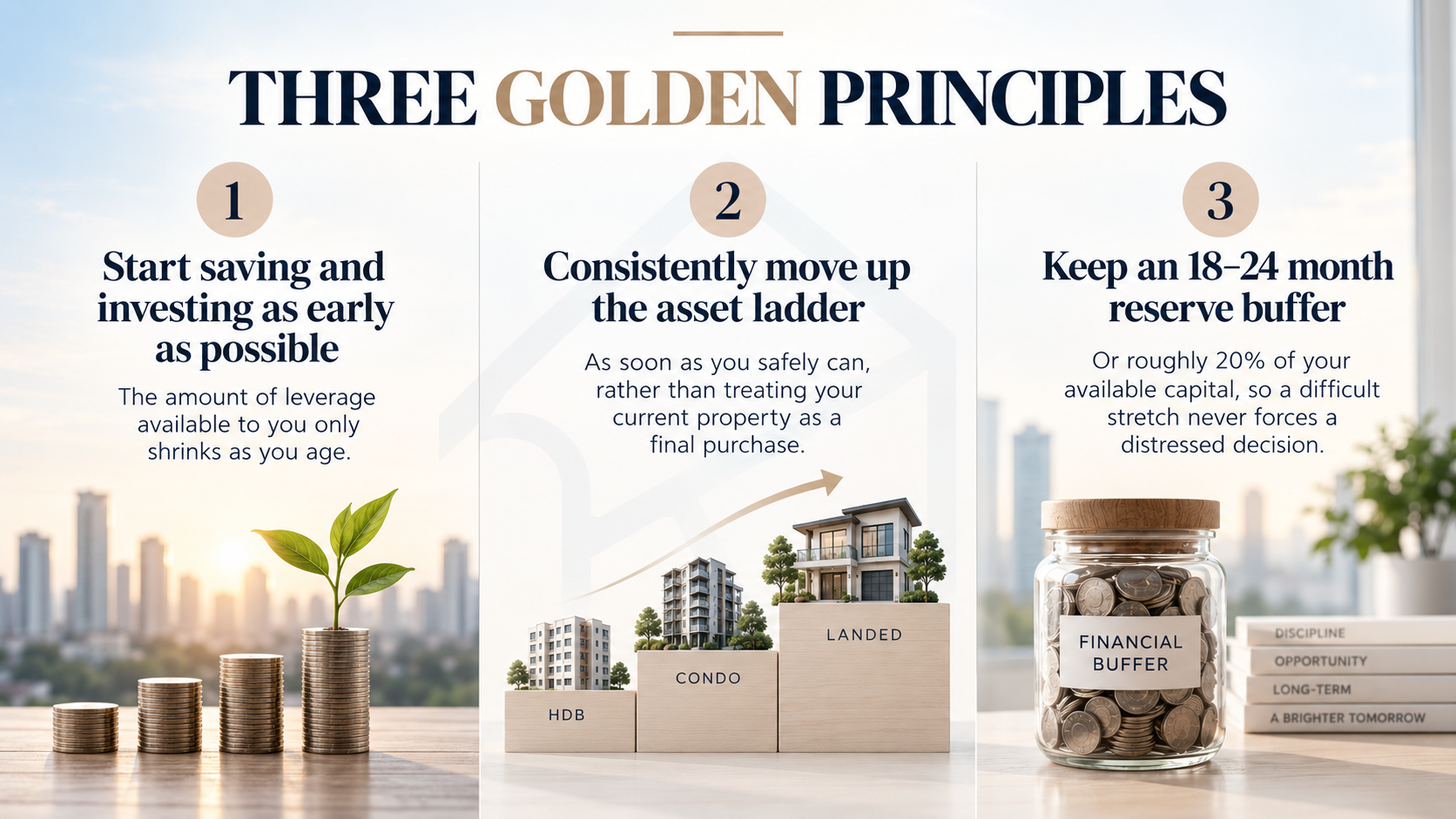
Three Principles That Apply Regardless of Which Option You Pick
How to Actually Decide
If your budget has room to stretch, and you're confident about your holding power, a landed property with a larger monthly buffer can make sense — you're paying for scarcity and long-term land value, not yield.
If you're comfortable with a moderate top-up and believe in the specific resale property's holding power and future demand, a resale condo can offer a more balanced middle ground between cash flow and immediate rental offset.
If you'd rather keep your monthly commitment light in the earlier years and are comfortable with a longer runway to completion, a new launch typically offers the lowest cash outflow upfront, with the trade-off of pricing certainty only resolving at TOP.
None of these is universally "correct" — the right answer depends on your own risk appetite, holding power, and how each monthly number actually feels against your other commitments. If you want to run this same comparison against your own numbers and current market pricing, that's exactly the kind of conversation worth having before you commit.
Get in touch with our team for a personalised assessment →

Have a specific area you're weighing?
Get in touch and I'll walk through what the Draft Master Plan means for your situation directly — no obligation.