
After my last post on the $2.5 million budget framework, one comment stuck with me: "Total income only 16K, want to buy a 2.6 million property, to begin with 720K accumulated either cash or CPF at age 30 — you must be way out of touch with reality." I'm not writing this to argue with anyone. I'm writing it because if you've never actually run the numbers, $720,000 by your early 30s sounds impossible. But the maths tells a different story — and I want to walk through it properly, because plenty of young buyers are getting there without a single dollar from their parents.
Wondering how this affects your own timeline?
Every zone and every buyer's numbers are different. Get a personalised read on the Draft Master Plan for your situation.
Setting the Context: Timelines Differ by Gender, and That Matters
In Singapore, women typically start full-time work at 22. Men usually start between 24 and 26, because of National Service and the delay it adds to graduation — even if the couple started dating back in junior college. This timeline gap matters more than people realise: by the time both partners hit their mid-to-late 20s, the female partner may already have 2 to 3 years of income and savings ahead of her partner.
Using realistic figures: a girl starting at $5,000 gross and a guy starting at $6,000 gross (including a year-end bonus); and applying a 5% annual compounding wage growth over 8 years, the girl's income grows to roughly $7,820 and the guy's to roughly $9,383. That's a combined household income in the $15,000–16,000 range by the time she's 30 and he's 34; well within reach of qualifying for a $2.5 million property under TDSR.
Is $5,000–6,000 Starting Pay Actually Realistic?
According to the latest Graduate Employment Survey, the median gross starting salary for a fresh graduate in Singapore sits at $4,500 — but this varies significantly by field and school. Info-communications and digital tech graduates lead the pack at around $5,600, while other clusters trail behind that. With normal increments, the occasional job hop, and a promotion or two, crossing into the $8,000–10,000 range by your early 30s isn't an outlier outcome — it's a fairly typical trajectory for many career paths, especially in tech-adjacent roles.
It's also worth being balanced here: income and property prices in Singapore have broadly tracked each other over the long run, but that's not true of every window. Between 2020 and 2024 specifically, private home prices rose faster than household incomes, pushing the average price-to-income ratio toward the upper end of its historical range. So "property is objectively less affordable than it used to be" isn't entirely wrong either — it depends which period you're comparing.
Running the Actual Savings Numbers
Take a 22-year-old and a 26-year-old, each saving $2,000 a month from their first year of work. After one year, combined CPF Ordinary Account contributions alone come to roughly $31,332. Add $48,000 in personal cash savings on top, and you're looking at roughly $80,000 saved in year one — before any compounding interest is even factored in.
Run that forward 8 years without compounding, and the combined total reaches roughly $673,000. Factor in CPF compounding interest on top, and you cross the $720,000–760,000 mark comfortably by the time the younger partner turns 30 — which is exactly the down payment threshold needed for a $2.5 million purchase.

One caveat worth flagging honestly: CPF OA contribution rates step down as you age — from 23% of wages below age 35, down to 21% for 36–45, and lower still after that — which is the government's way of gradually redirecting savings toward retirement adequacy. That's precisely why starting early matters more than almost anything else in this equation — the earlier your CPF OA is building, the more runway you get before those rates taper.
Five Principles Behind the $2.5 Million Roadmap
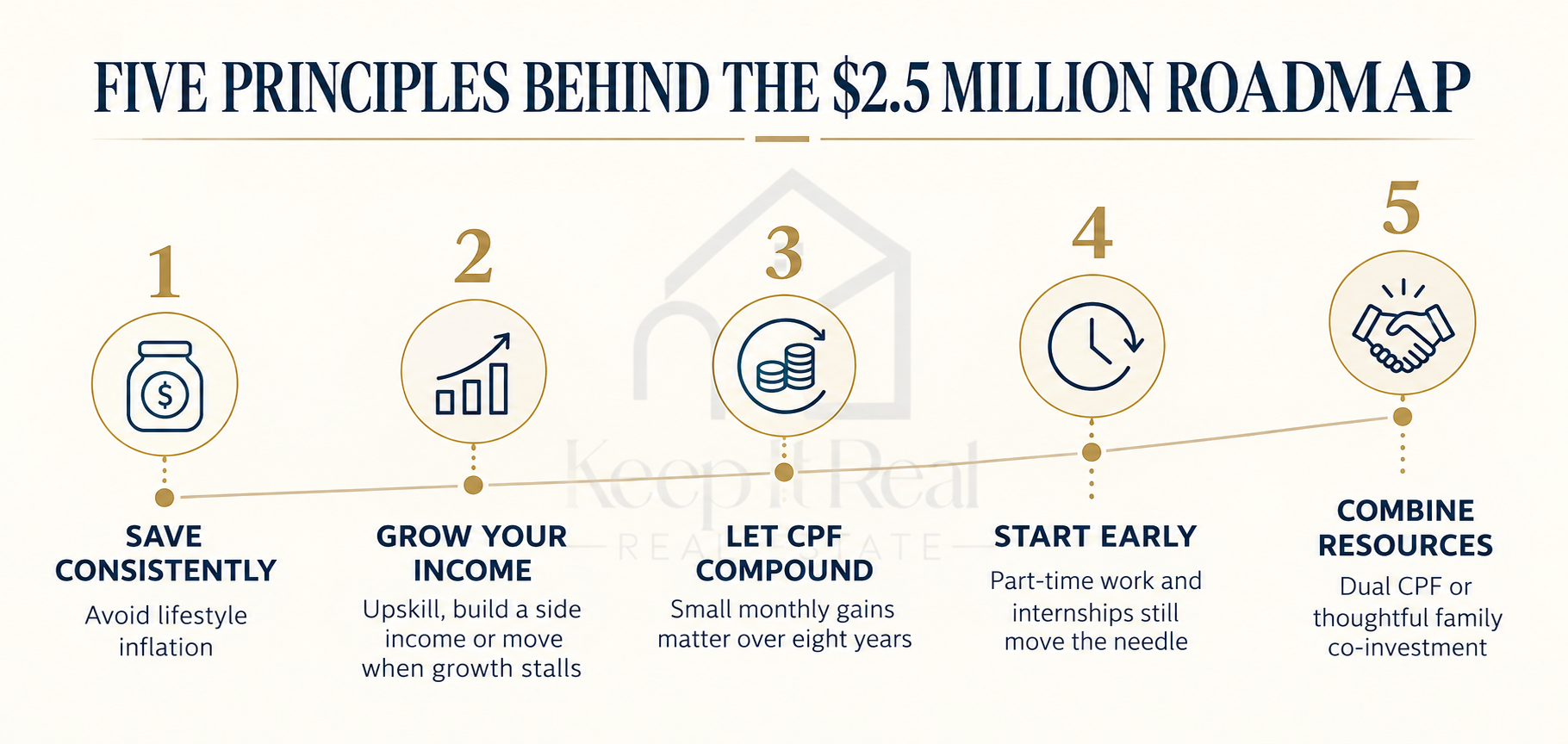
Consistent savings without lifestyle inflation. The trap isn't earning too little — it's letting every pay increase get absorbed into higher spending, so someone earning $12,000 is still only saving what they saved at $5,000.
Actively grow your income. Through upskilling, side hustles, or a job hop when it's clear your current role has hit its ceiling. Staying somewhere purely out of comfort has a real cost.
Don't underestimate CPF compounding. It's slow and invisible month to month, but it's doing meaningful work over an 8-year horizon.
Start as early as possible — even part-time work and internships during school genuinely move the needle.
Combine resources where it makes sense. Dual income means dual CPF. And if you're a single income earner, co-investing with parents — where they contribute liquidity and you contribute better loan eligibility — is a legitimate, common structure, not something to feel awkward about.
My Honest Take
None of this is a guarantee, and I'm not claiming every 30-year-old in Singapore can or should be buying a $2.5 million property — for many households, a more modest budget is the right and responsible choice, and there's nothing wrong with that. What I am saying is that dismissing the entire roadmap as fantasy usually comes from not having actually run the numbers, rather than the numbers themselves being wrong.
If you're a young couple trying to figure out whether your own timeline realistically supports a property goal like this — or a more conservative one — that's a conversation worth having early, while you still have the maximum number of years for compounding to work in your favour.
Get in touch with our team for a personalised assessment →

Have a specific area you're weighing?
Get in touch and I'll walk through what the Draft Master Plan means for your situation directly — no obligation.