If you already own a HDB flat and are weighing whether — or when — to upgrade to private property, you've probably heard every version of the same advice: "prices are too high right now," "wait for a correction," "your friend bought cheaper three years ago." I hear this from clients constantly, and it's usually the biggest thing holding well-informed buyers back from making a decision that the numbers actually support.
I've lived this decision from the inside. In 2013, my wife and I bought our first HDB flat for $600,000. Seven years and several transactions later, we had consolidated into a landed home in Singapore's core central region — a property now valued at roughly $10 million. This isn't a lifestyle story about chasing a bigger house. It's a case study in how disciplined, data-backed upgrading decisions compound over time.
Wondering how this affects your own timeline?
Every zone and every buyer's numbers are different. Get a personalised read on the Draft Master Plan for your situation.
Upgrading Isn't a Lifestyle Choice — It's a Retirement Strategy
The instinct many owners have is to treat their HDB flat as the "safe" choice and private property as an aspirational upgrade they can put off indefinitely. I'd argue this framing misses the real financial mechanics at play.
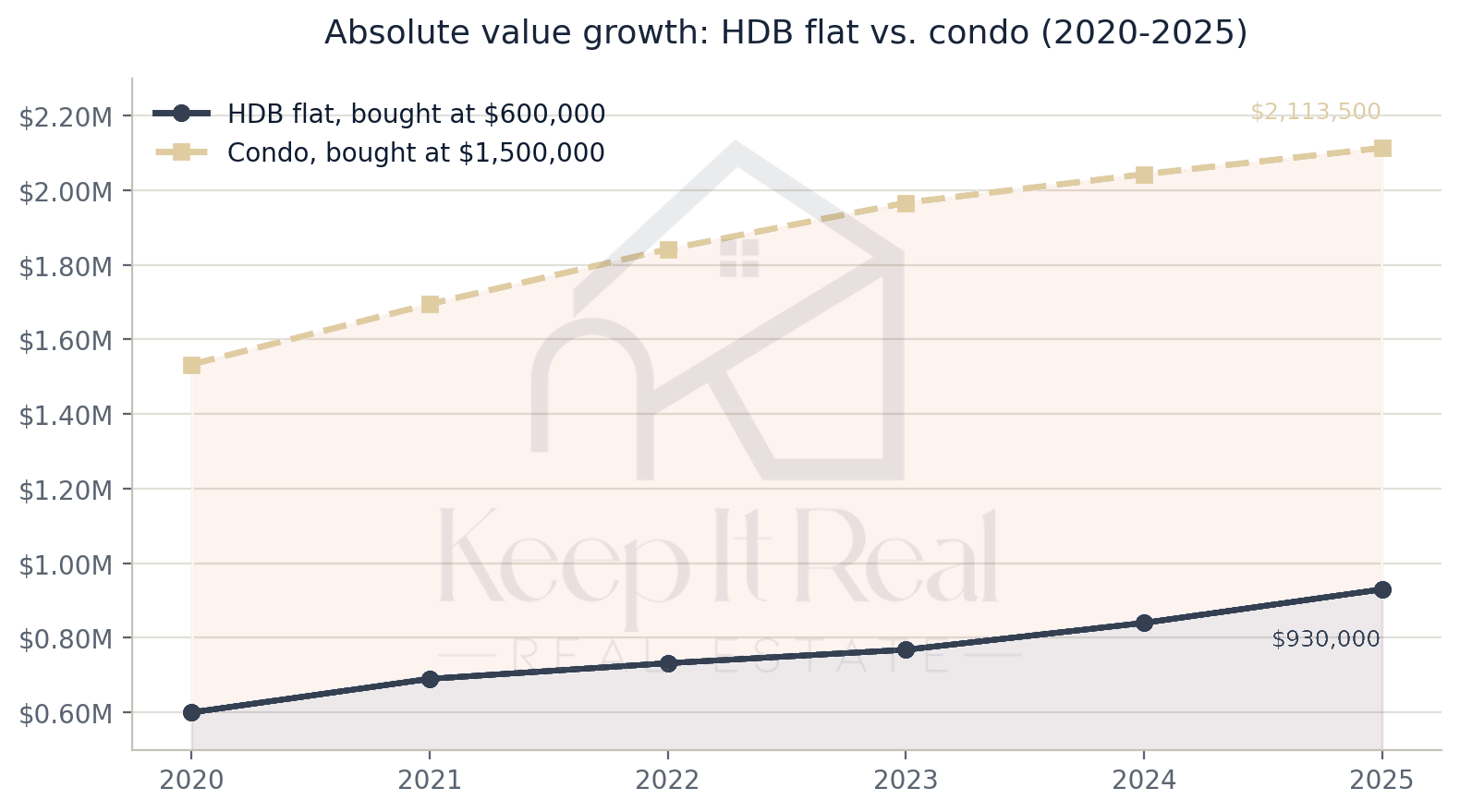
Here's the core issue: even when HDB and private property grow at similar or comparable percentage rates, the dollar impact is completely different because of the size of the base you're compounding on. Between 2020 and 2025, HDB resale prices climbed roughly 55%, actually outpacing private property's roughly 41% growth over the same stretch. But run those same percentages against real entry prices, and the picture flips: a HDB flat bought at $600,000 grows to about $930,000. A condo bought at $1.5 million — growing at the slower percentage rate — still ends up worth roughly $2.12 million. The absolute gap in wealth created is nearly $1.2 million, purely because of the base you started from.
 That gap matters most when you think about retirement. A household living in a fully paid-off HDB flat that later downgrades to a smaller resale flat may walk away with meaningfully less retirement cash than a household that upgraded to private property early and later sold down. I like to use my own parents' situation as an example: a flat bought decades ago for under $50,000, now worth roughly $500,000 — solid growth in isolation, but modest compared to what a private property bought at a similar entry point would likely be worth today.
The "Best Time to Buy Was 5 Years Ago" Problem
One of the more counterintuitive points in my framework: every generation of buyers thinks they're entering at the top. When I joined the industry, seasoned agents were already saying prices were too high compared to years earlier. When I bought my own first upgrade property, the same conversation was happening. Looking back at Singapore's property price index over multiple cycles, a consistent pattern shows up — each new high tends to exceed the previous high, and each dip tends to bottom out higher than the prior dip. Sustained declines longer than a few years are rare.
This doesn't mean timing doesn't matter, or that every purchase is a good one. It means the "wait for it to drop" strategy has a poor track record for buyers who are already financially ready, because the data suggests the wait is usually longer and more expensive than anticipated.
Worth noting too: buyer demographics are shifting. Data from property research shows the average age of new-launch buyers has dropped meaningfully over the past decade, with a growing share of buyers now under 35 — driven by rising incomes, longer loan tenures, and more financially literate parental support. Younger buyers are entering the market earlier, not later.
A Framework for Upgrading Safely — Not Just Aggressively
To be clear, I'm not advocating upgrading recklessly. My approach rests on three principles:
Start saving and investing as early as possible. The earlier the timeline, the more compounding works in your favor.
Consistently grow your net worth through upgrading, rather than treating your first property as a final purchase.
Maintain a financial buffer — enough to weather 18–20 months of reduced income or unexpected difficulty — so that a downturn never forces a distressed sale.
Practically, this means running the numbers before committing: assessing combined household income, keeping mortgage installments within a sensible share of take-home pay, and being honest about renovation spending so it doesn't erode the equity you're trying to build.
For owners who've already sold their HDB and are sitting on the sidelines waiting for prices to drop before buying their next property, I'd flag this as one of the more financially exposed positions to be in — cash sitting uninvested rarely outpaces property price growth over the medium term, and there's no guarantee prices will fall at all.
Is Upgrading Right for You?
Every household's numbers look different — combined income, CPF balances, risk tolerance, and timeline all change the calculation. The framework above is a starting point, not a substitute for running your own figures.
If you're a HDB owner considering the move to private property, or you already own private property and are weighing the next step, get in touch and I'll walk through your specific numbers and timeline with you — the same way I do with every client before any purchase decision is made.

Have a specific area you're weighing?
Get in touch and I'll walk through what the Draft Master Plan means for your situation directly — no obligation.